Showing posts with label Mineral paper. Show all posts

June 2, 2022

Experiments in wet cyanotype - part 75

Sue Reno_wet cyanotype_image 959
My usual spring gardening activities were delayed this year, due to unseasonable cold and wet weather. So May turned into a very busy and intensive foray into pruning and planting. I moved here in the summer of 2019, and most of the first year was spent rejuvenating existing plantings and fighting a massive thistle invasion; after that I was able to begin to shape things to my liking. This spring it seems like the plan is finally coming together.
Sue Reno_wet cyanotype_image 960
Anyway, part of the pruning involved a leatherleaf viburnum, which has taken off with great enthusiasm and needed some guidance and shaping. The leaves are very, well, leathery, but also have a lot of fine bristles on them. I thought they would be ideal for some long exposure wet cyanotype prints.
Sue Reno_wet cyanotype_image 961
I set up a bunch of them on mineral paper, my current/ongoing obsession, and also did two larger ones on cotton sateen. I added just a small amount of Solarfast green to the chemical mix. This first batch of photos is before exposure.
Sue Reno_wet cyanotype_image 962

Sue Reno_wet cyanotype_image 963

Here they are after exposure and before rinsing. 
Sue Reno_wet cyanotype_image 964

The little bristles on the surface of the leaves adhered fairly firmly to the surface of the mineral paper in a lot of spots.

Sue Reno_wet cyanotype_image 965

Rather than try to pick them off and risk damaging the paper, I decided to wait and gently soak the leaf fragments off in the rinse.
Sue Reno_wet cyanotype_image 966

Sue Reno_wet cyanotype_image 967

On the sateen prints this was less of a problem.
Sue Reno_wet cyanotype_image 968

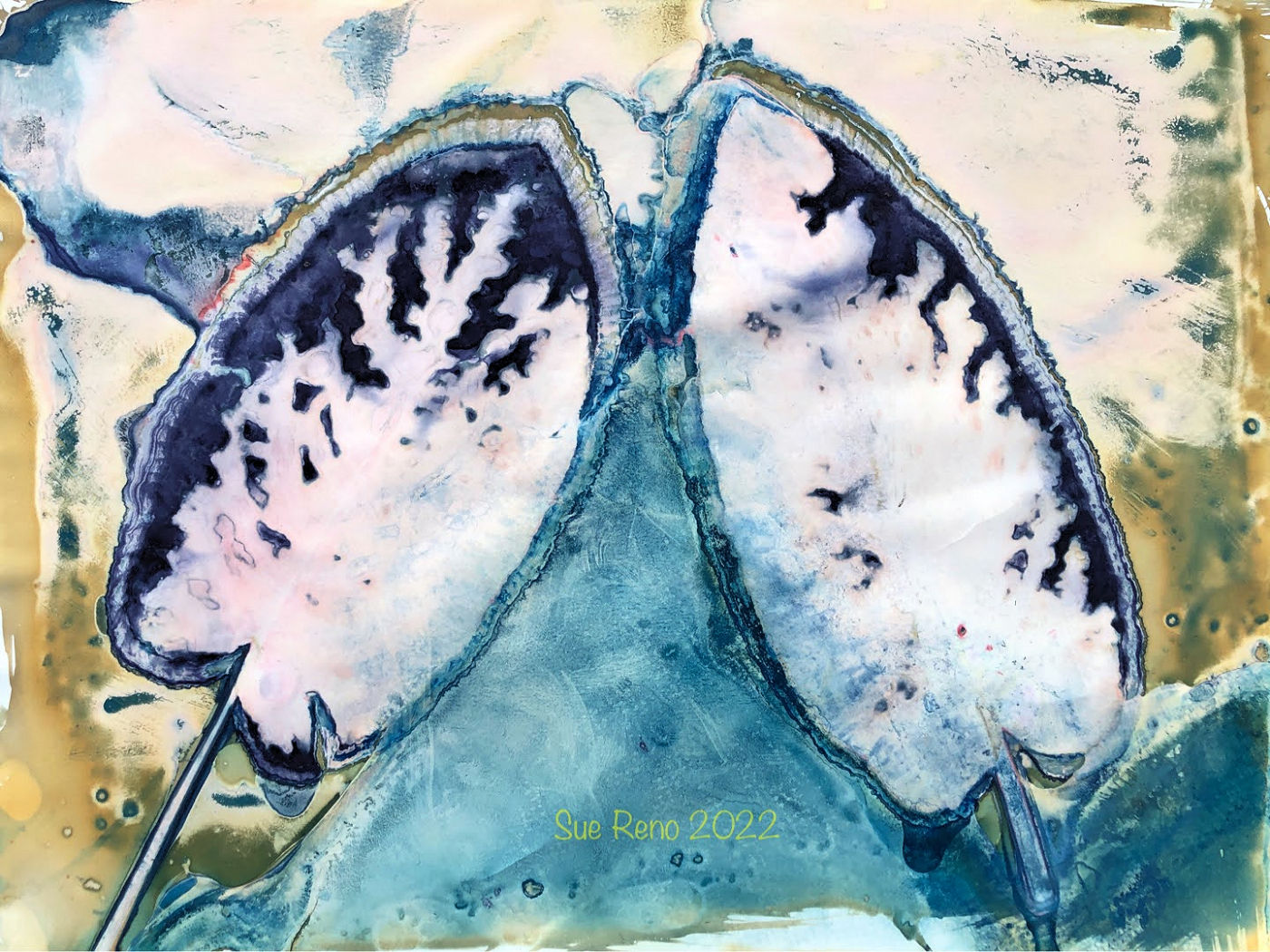
Here are the finished prints. They were well worth the little bit of extra trouble!
Sue Reno_wet cyanotype_image 969
There's tons and tons of variation to look and marvel at.
Sue Reno_wet cyanotype_image 970

Sue Reno_wet cyanotype_image 971

So unpredictable and so cool.
Sue Reno_wet cyanotype_image 972

The prints on the sateen are a little less wild but no less lovely.
Sue Reno_wet cyanotype_image 973
This last image is number 974 that I've posted since I started documenting my wet cyanotype experiments, so I'm quickly approaching 1,000 with no sign of slowing down. I hope some of you have been enjoying coming along for this ride as much as I've enjoyed sharing it.
Sue Reno_wet cyanotype_image 974


Thanks as always for reading! You can also follow along on your platform of choice:


May 29, 2022

Experiments in wet cyanotype - part 74


Sue Reno_wet cyanotype_image 944
After a long, wet, and dreary winter and early spring, the weather finally turned and I had the motivation and the time to do a few wet cyanotype prints. (I clocked a lot of time during the dreary days at the machine, stitching on new quilts, with results to follow later.)
Sue Reno_wet cyanotype_image 945

A quick tour around the garden and woods turned up some vibrant burdock leaves, a sprig of bleeding heart leaves, and a fresh fern frond. I set these up with the mixture of cyanotype chemicals, plus a small squirt of Solarfast solar dye, on mineral paper, my current favorite non-fabric substrate.
Sue Reno_wet cyanotype_image 946
Out they went into the bright spring sunlight. I also prepped a cotton sateen panel with more bleeding heart leaves and a Kousa dogwood twig. None of this was carefully thought through, I just wanted get back into practice at summoning up that old wet cyan magic.

Sue Reno_wet cyanotype_image 947

After exposure but before rinsing, it was looking like I still had the touch. There's so much going on with the burdock leaves!

Sue Reno_wet cyanotype_image 948

Along with lots of cool swirly stuff with the bleeding heart and fern.
Sue Reno_wet cyanotype_image 949

Sue Reno_wet cyanotype_image 950

In the fabric print, you can see hints of the red Solarfast.
Sue Reno_wet cyanotype_image 951

And here are the finished prints. 
Sue Reno_wet cyanotype_image 952

Sue Reno_wet cyanotype_image 953
Mineral paper is such an interesting product.  Made with rock derived calcium carbonate and a small amount of binder, it is smooth and water resistant, so at first the cyanotype chemicals swirl all around. but at some point, while baking in the hot sun, they begin to adhere to the paper, with the leaves providing an imperfect resist. I can only partially control the process, which is why I find it endlessly fascinating.
Sue Reno_wet cyanotype_image 954

Sue Reno_wet cyanotype_image 955

Sue Reno_wet cyanotype_image 956

Sue Reno_wet cyanotype_image 957
I am also pleased with the print on cotton sateen, there's lots of subtle circular patterning and crisp leaf edges. All together it's a good start to the printmaking season.
Sue Reno_wet cyanotype_image 958


Thanks as always for reading! You can also follow along on your platform of choice:


November 23, 2020

Experiments in wet cyanotype - part 56

Wet Cyanotype_Sue Reno_Image 798
Still catching up on documenting the summer's prints sessions. This was the last batch of wet cyanotype prints on mineral paper, made in the last warm and mellow days of September.
Wet Cyanotype_Sue Reno_Image 799
The first two are fern fronds from my garden.
Wet Cyanotype_Sue Reno_Image 800
Followed by a maple twig, and a bit of the horribly invasive but good for printmaking Japanese knotweed.
Wet Cyanotype_Sue Reno_Image 801
Here are the prints after exposure, but before rinsing and finishing.
Wet Cyanotype_Sue Reno_Image 802

Wet Cyanotype_Sue Reno_Image 803
Once again, I am delighted by the way the chemicals move around on the slick surface of the mineral paper before settling down and permanently staining it. 
Wet Cyanotype_Sue Reno_Image 804
Those rusty tones are spectacular but will rinse out, so I'm glad I always take a moment to record them at this stage.
Wet Cyanotype_Sue Reno_Image 805
Here are the finished prints.
Wet Cyanotype_Sue Reno_Image 806
So much swirly goodness!
Wet Cyanotype_Sue Reno_Image 807

Wet Cyanotype_Sue Reno_Image 808
And nice crisp leaf outlines on the knotweed print. November has turned a bit dreary, as per usual, and it's good to have some summery goodness to reflect back on.
Wet Cyanotype_Sue Reno_Image 809
A reminder that you can also follow on your platform of choice:


October 30, 2020

Experiments in wet cyanotype - part 55

Wet Cyanotype_Sue Reno_Image 786
Reporting in with another batch of wet cyanotype prints on mineral paper, made at the tail end of a warm and sunny September.
Wet Cyanotype_Sue Reno_Image 787
This batch is 4 different arrangements of wild fox grape leaves, damaged by the usual ravages of weather and insects.
Wet Cyanotype_Sue Reno_Image 788
Once again, I marveled at how the cyanotype chemicals swirled around on the paper at the beginning of the exposure. The bulk of my wet cyan work has been done on fabric, which absorbs the chemicals and behaves very differently.
Wet Cyanotype_Sue Reno_Image 789
Here's the prints after exposure, but before rinsing.
Wet Cyanotype_Sue Reno_Image 790
I put these out on a hot afternoon, then got distracted. It was a full 24 hours before I had a chance to remove the leaves and bring the prints indoors.
Wet Cyanotype_Sue Reno_Image 791
I got a lot a really interesting colors and designs in that time period; however, that was counterbalanced by the way the leaves got dried and stuck onto the paper in places.
Wet Cyanotype_Sue Reno_Image 792
I had to spend some time soaking and very, very gently scrubbing to remove the leaf fragments. 
Wet Cyanotype_Sue Reno_Image 793
So while I would not recommend this degree of over-exposure, the results are very unique and beautiful! Here are the finished prints.
Wet Cyanotype_Sue Reno_Image 794
There is so much variation in tone and intensity in these.
Wet Cyanotype_Sue Reno_Image 795
I think they capture that end-of-summer, brink-of-decay moment really well.
Wet Cyanotype_Sue Reno_Image 796
This one shows a lot of the leaf veining as well. 
Wet Cyanotype_Sue Reno_Image 797
A reminder that you can also follow on your platform of choice: