April 22, 2013

Silk Mill #3 Acceptance into Art of the State

SueReno_SilkMill3
Silk Mill #3
I’m thrilled and honored to announce that my latest work, Silk Mill #3, has been accepted into “Art of the State: Pennsylvania 2013”.  This prestigious exhibit will open June 23, 2013 at the State Museum of Pennsylvania in Harrisburg, and run through September 8th.

There were 137 works chosen from a field of 1,934, putting the acceptance rate at about 7%.  This is an all-media exhibit; the juror for Sculpture and Three Dimensional Craft was Wendelyn W. Anderson.
SueReno_SilkMill3Detail3
Silk Mill #3, Detail
I’ve been fortunate enough to have work in this venue in previous years; it’s a really wonderful and elegant setting, and they throw a great opening reception/awards ceremony.  I’m looking forward to it, and to seeing all the other guaranteed-to-be-excellent work on display. Perhaps I’ll see you there!

To learn more about Silk Mill #3, and the others in the series, see yesterday's post, or click the Silk Mill tab at the top.

As always, thanks for reading and commenting.

April 21, 2013

New Work - Silk Mill #3

SueReno_SilkMill3
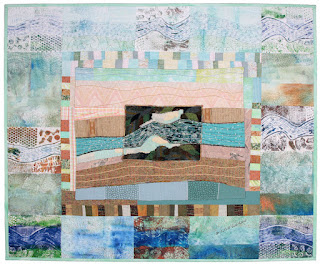
I’m excited to reveal my latest work, Silk Mill #3.  It is based on an photographic image I took of the historic Ashley and Bailey silk mill, circa 1899, in Columbia, PA.  The building was abandoned in the 1970’s and fell into disrepair.  It has recently undergone renovation, and a portion of it has been repurposed as the Turkey Hill Experience, an tourist attraction run by the popular local dairy company. 

SueReno_SilkMill3Detail1
I took a lot of pictures of it just before the renovation began. I am fascinated by historic buildings with strong architectural lines that have become open to the elements.  (See my Watt & Shand series of art quilts, also in my Structures Gallery and here on my blog.) This structure had broken and missing windows, with the sun shining through them, and a portion of the roof missing.  There were plants growing on it and in it.  But its basic integrity warranted its preservation and re-use. 
SueReno_SilkMill3Detail2
This work measures 53” h x 60”w.  The central images are from altered photos, made into thermofax screens, and screened onto hand painted fabrics.  The patchwork is a mix of commercial and hand painted silk, cotton and wool fabrics.  The inner border is the same photo, which I had commercially printed onto silk yardage.  I am particularly happy with the way I was able to move the color fields across the work. 

To see more about the works in this series and their evolution, along with the source photos, click on the Silk Mill tab at the top, or go here.  All the photos here and on my website can be enlarged by clicking.

I hope you enjoy viewing this as much as I enjoyed making it, and as always, thanks for reading and commenting.

April 18, 2013

Skunk and Garlic Mustard acceptance into Images 2013

SueReno_SkunkAndGarlicMustard
I am delighted to announce that Skunk and Garlic Mustard has been accepted into Images 2013, the juried gallery exhibition of the Central Pennsylvania Festival of the Arts.  The juror is Joyce Robinson, curator of the Palmer Museum of Art.  Images 2013 will hang in the Robeson Gallery on the University Park campus of the Pennsylvania State University from June 5 to July 14, 2013. 

SueReno_SkunkAndGarlicMustardDetail1
I’ve been privileged to have work in this premier regional exhibit in past years--I’ve even won some awards--and I am always very impressed with both the quality of the works selected for the exhibits, and with the exhibit space itself and how well the staff utilizes it.  I’m looking forward to the opening reception on June 7th; perhaps I’ll see you there!

SueReno_SkunkAndGarlicMustardDetail2
Skunk and Garlic Mustard is part of my Flora and Fauna series, where I am working with the skulls of native wildlife in conjunction with plant monoprints and vintage textiles.  For this piece, I had the luxury of an entire skunk skeleton to photograph and use for cyanotype prints.  I love the delicacy and beauty of these small organic artifacts, and marvel at how they once worked as a whole to support such an interesting and successful life form. 

The vintage component in the work is the bit of french knot embroidery running down the right panel.  It was a gift from a kind friend, so like many vintage textiles I don’t know its provenance but can only appreciate the skill of whoever stitched it.  The botanical print is a heliographic monoprint, made on silk with textile paints, of the horribly invasive garlic mustard plant.  Despite the time I spend cursing it and pulling it, I can’t help but admire its energy and beauty.

As always, thanks for reading and commenting.

April 12, 2013

Interviewed by Amber Kane

Amber Kane is a fellow fiber artist who works with weaving and crochet to create beautiful and unique designer scarves.  She is producing a series of interview with other artists, and I sat down with her recently, via Skype, to engage in a dialogue over a wide range of artistic topics.  We discuss process,  studio practice, defining an artistic voice, and finding the courage to forge your own identity and creative path.

Amber posted it on YouTube with the tag line:  “What did you love doing as a child?  Sue Reno loved sewing, and she never stopped”.  True!  But of course there's a lot more to the story.  The clip is long-ish, at 26 minutes, but I promise you it is worth your time.


Thanks, as always, for reading and for viewing.

March 11, 2013

Rabbit and Maple - Work in Progress Update 4

SueReno_RabbitAndMaple_InProgress10

The vintage component of this work is multifaceted.  I began with some embroidered blocks that I bought on eBay years ago.  They were dingy, and someone had appliqued odd butterflies on top of them, but they cleaned up beautifully and are of excellent quality.  At the time I posted a query on a listserve--remember those?-- and a kind soul snail mailed me a photocopy of an article by quilt historian Barbara Brackman.  I can’t find it online, but in summary it identifies my blocks as designed by Eveline Foland, who was associated with the Kansas City Star newspaper.  The “Memory Bouquet” set of twenty patterns was published in October and November of 1930.  I really love the graceful, flowing lines of her designs.  They seem timeless.

I built out the blocks with solid colored triangles, then added pieced triangle blocks.  The fabrics I used are from my personal collection, which begins with scraps from my mother’s housedresses sewn in the 1940’s.  A lot of the ones I pulled from the stash for this project were from my own garment sewing when I was in high school and made most of my own clothes.  It’s a bit odd to think that part of my personal history now loosely qualifies as vintage…..I am paying tribute to a lot of women who stitched and sewed with this work, my past self included!
SueReno_RabbitAndMaple_InProgress12
I paint a lot of the fabric I use in my work, starting with pfd (prepared for dying) silks and cottons.  I don’t dye fabric, the process doesn’t appeal to me, and for the most part I don’t feel the need to acquire hand-dyes.  However,  now and again I come upon an artisan whose dye work blows me away.  I’ve used some of Deb Lacativa’s sugar dyed textiles in several of my pieces; there’s nothing else like them.  Lisa White Reber is another artist who has caught my interest.  I first met her online, and then talked with her in person a few times.  I am in awe of her technical knowledge and expertise, and the way she applies it to make unique art cloth.  A year ago at a quilt show I bought some yardage that she treated with multiple processes. I thought it was stunning, and it put it aside to await its moment.  With this project I realized it was completely appropriate for the patchwork and to build out the borders.  A visitor to my studio observed that the patterning resembled Rorschach-esque stylized rabbits, and while that did not consciously play into my decision to use it, it’s just possible that my subconscious was on the job.  See Lisa’s work for sale at her Dippy Dyes site, and check out her blog.  (Disclaimer--I have no affiliation to Deb or Lisa, and this is not a sponsored post.  I’m just a fan.)
SueReno_RabbitAndMaple_InProgress11
What with the multiple rabbits, and two big maple prints, and 6 patchworked vintage blocks, and the bits and bobs and borders that I used to make it all  work together, the finished top turned out on the large side by my standards, roughly 75” by 88”.  I am very, very happy with the design and assembly.  I will be less happy once I am wrestling it under the machine to quilt it, but so it goes.  Quilting will have to wait for a bit as I am heavily into a design furor right now, and I am about to be distracted by the arrival of spring.

Bonus footage!  I was interviewed by the local paper as part of a story about the AQS Quilt show that’s coming to Lancaster, PA this week.  You can read the article here.  At the end, there’s a short video of me in the studio, and at one point I briefly display the finished Rabbit and Maple top.  Go take a look, and enjoy!

Addendum:  the newspaper just published the interview as a YouTube video.

March 10, 2013

Article re: AQS Lancaster

I'm featured in an article in today's local paper about the AQS show coming to Lancaster, PA this week.  My quilt, Ginger, is illustrated, and I'm quoted as part of an excellent exposition on the international character of the quilt world today.  There's also a brief video clip of me in my studio.  Read all about it here.

Enjoy!

March 8, 2013

Rabbit and Maple - Work in Progress, Update 3

SueReno_RabbitAndMaple_InProgress7
A truism about rabbits is their ability to reproduce with rapidity.  There’s never just one  in my neighborhood; there’s a plethora of them bounding about in the spring.  So I wanted a multiplicity of rabbit prints for this new addition to my Flora and Fauna series.
SueReno_RabbitAndMaple_InProgress8
This side image highlights the workings of the jaw and those big rabbity teeth. You can also see the underlying structure for the twitchy nose. 
SueReno_RabbitAndMaple_InProgress9
I like the way the tight circular stitching both highlights and grounds the imagery.

If you take a look at some of the other works in this series, like Skunk and Garlic Mustard:
Skunk and Garlic Mustard
Squirrel and Locust:
Squirrel and Locust
and Deer and Mayapple:
Deer and Mayapple
You can see that this is not a macbre treatment of the skull imagery.  The work is verging on cheerful.  As I'm working I consider it a celebration of all the small lives that are woven around mine here in the imperfect but beautiful surbuban wilds of Lancaster County.  You are of course welcome to bring your interpretation to the party.


As always, thanks for reading and commenting.

March 7, 2013

Rabbit and Maple - Work in Progress, Update 2

SueReno_RabbitAndMaple_InProgress4
Rabbit skull
I am sometimes asked where I obtain the skulls I am working with in this series.   Several of them were loaned to me by a friend who spends a lot of time in the woods and has a good eye and a special knack for spotting treasures.  Others I bought online, from a taxidermist who prepares small mammal skulls as a sort of sideline.  I think they are things of beauty, insanely interesting in their structures and their adaptations for their ecological niche and specialized diets. 
SueReno_RabbitAndMaple_InProgress5
Rabbit skull negative image
I spent a lot of time taking photographs of the skulls.  In photography as in many endeavors I am largely self-taught, so I had to work out the intricacies of lighting, lenses and exposures through educated guesswork and trial and error.  Once I had an image I liked, I messed around with it in a photo program to turn it into what is essentially the equivalent of a photo negative.  The negative image gets printed on a acetate transparency sheet and used to expose and print the cyanotype.
SueReno_RabbitAndMaple_InProgress6
Stitched rabbit skull cyanotype
Above is a print after stitching. I had fun doing the small circular patterning, and it really makes the image pop. 
As always, thanks for following along.