October 9, 2023

Experiments in wet cyanotype - part 86

Sue Reno_wet cyanotype_image 1057
More of this summer's adventures in wet cyanotype with a big batch of prints on mineral paper.
Sue Reno_wet cyanotype_image 1058
Mineral paper is made from calcium carbonate, with an added binder. The surface is very slick, and it absorbs water slowly, which makes it ideal for my purposes - the cyanotype chemicals move about freely at the beginning of the exposure, making for some very cool effects.
Sue Reno_wet cyanotype_image 1059
This set starts with 3 calla leaves, then 3 different fern fronds.
Sue Reno_wet cyanotype_image 1060
I consider callas and ferns some of the staples of my perennial shade gardens, both for their reliability and for their printmaking potential. I never tire of them in either capacity.
Sue Reno_wet cyanotype_image 1061
If memory serves, I added a few drops of Solarfast chemicals into the cyanotype mix.
Sue Reno_wet cyanotype_image 1062

Above are the panels before exposure: below is after a long exposure in the strong September sun.
Sue Reno_wet cyanotype_image 1063
I let them dry and cure overnight before rinsing them out. Unlike fabric, it only takes a light touch to process them.
Sue Reno_wet cyanotype_image 1064

Sue Reno_wet cyanotype_image 1065
Often they are so beautiful at this stage that I can hardly bear it. 

Sue Reno_wet cyanotype_image 1066

Sue Reno_wet cyanotype_image 1067

Sue Reno_wet cyanotype_image 1068
Here are the finished prints.

Sue Reno_wet cyanotype_image 1069
There's a strong focal point in each, and a whole lot going on in the background.
Sue Reno_wet cyanotype_image 1070

Sue Reno_wet cyanotype_image 1071
Just like wet cyan on fabric, there's a lot about the process that is beyond control, but I am learning how to manage parts of it. These prints just keep getting better and better.
Sue Reno_wet cyanotype_image 1072

Sue Reno_wet cyanotype_image 1073

Sue Reno_wet cyanotype_image 1074

As always, thanks for reading! A reminder that this blog is packed full of all kinds of good info, so have some fun exploring the tabs in the top header. Also an admin note-- I have left the dumpster fire that was once twitter, and am now posting on Threads. Pick your platform to find and follow my content: 

September 27, 2023

Art Quilts: Breaking Rules, Honoring Tradition - acceptances

Under the Pink Moon, art quilt by Sue Reno
Under the Pink Moon
I am thrilled and honored to share that two of my art quilts, Under the Pink Moon and Under the Thunder Moon, have been selected by juror Shelly White to be included in Art Quilts: Breaking Rules, Honoring Tradition, at the Vision Gallery in Chandler, AZ. The exhibit will run from November 18, 2023 - January 12, 2024.
Under the Pink Moon, art quilt by Sue Reno - detail
Under the Pink Moon - detail
Both quilts are part of an emerging series where I examine folkloric names for the full moon throughout the year. Under the Pink Moon represents April, when the full moon shines down on the tender emerging foliage and flowers of spring. The center panels are direct solar dye prints of garlic mustard, Virginia creeper, and dock leaves, all very prevalent in the woodlands of Pennsylvania. The vintage hexagon blocks, pieced from feedsack cottons, are bordered with vivid silks.

Materials: artist-painted and commercial cotton and silk fabric, vintage patchwork hexagons

Techniques: wet process solar dye botanical prints, piecing, stitching

Size: 49”h x 34”w

Under the Thunder Moon, art quilt by Sue Reno
Under the Thunder Moon
Under the Thunder Moon represents July, in reference to this month’s frequent thunderstorms. These wet cyanotype prints capture the effect of moonlight on some of the perennial stars in my garden borders.

Materials: artist-painted and commercial cotton, silk, and wool fabrics

Techniques: wet process cyanotype prints on cotton, patchwork, stitching

Size: 39"h x 23"w

Under the Thunder Moon, art quilt by Sue Reno - detail
Under the Thunder Moon - detail

As always, thanks for reading! A reminder that this blog is packed full of all kinds of good info, so have some fun exploring the tabs in the top header. Also an admin note-- I have left the dumpster fire that was once twitter, and am now posting on Threads. Pick your platform to find and follow my content: 


September 23, 2023

Experiments in wet cyanotype - part 85

 I always like to acknowledge the equinoxes (and the solstices) in some way; this time around I chose to make some wet cyanotype prints, using the power of the waning solar rays.

Sue Reno_wet cyanotype_image 1096
First up are leaves on noil, or raw, silk. It's a heavy, textured fabric, with enough sericin left in it that it's hard to wet. I had previously treated this fabric and left it to dry slowly, so for these prints I sprayed it down with water before laying down the leaves. Above are fig leaves, and below is spikenard.

Sue Reno_wet cyanotype_image 1097

Spikenard is new to me. It needs to be transplanted young, and given time for its taproot to establish. This is its third year and it has exploded in size. I have a tendency to crowd things in the garden, and these are making me wish I had given them a bit more room, but at least this way I feel no pangs when I trim off some sprigs for printmaking. 
Sue Reno_wet cyanotype_image 1098
Next up are three fig leaves. This is my first year growing figs, I've always been a bit intimidated by them, living on the cusp of where they can overwinter, but I've got some new varieties and I'm giving it a try, with one in the ground and one in a pot I'll store in the garage. As you can see, the leaves are fading, so again no guilt in harvesting a few. 
Sue Reno_wet cyanotype_image 1099
These are on mineral paper, which is tremendous fun to experiment with.

Sue Reno_wet cyanotype_image 1100
The day was sunny and warm, but very autumnal, lacking the intensity of a summer day. Making wet cyanotypes in the off-season is always a bit of a gamble, but of course it's not a high stakes game.
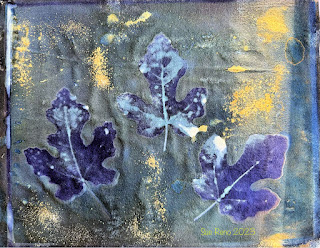
Sue Reno_wet cyanotype_image 1101
Here are the prints after exposure, but before rinsing. The yellow bits are grains of washing soda, which alters the pH and produces funky effects. 
Sue Reno_wet cyanotype_image 1102
I love the cool colors in the center of the mineral paper prints, but they are there because the heat was not intense enough to wick the chemicals out from under the leaves. It will change a good bit in the rinse out.
Sue Reno_wet cyanotype_image 1103

Sue Reno_wet cyanotype_image 1104
I tossed a bit of washing soda on this one as well, because why not.
Sue Reno_wet cyanotype_image 1105
Here are today's finished prints. The silk noil gives the prints a subdued, almost watercolor effect.
Sue Reno_wet cyanotype_image 1106
These are going to look lovely once I add stitching for definition.
Sue Reno_wet cyanotype_image 1107
How funky are these mineral paper prints? Lots of cosmic orb action happening here.
Sue Reno_wet cyanotype_image 1108
I like the way the leaves appear to be encased in an embryonic sac. 
Sue Reno_wet cyanotype_image 1109

Sue Reno_wet cyanotype_image 1110

As always, thanks for reading! A reminder that this blog is packed full of all kinds of good info, so have some fun exploring the tabs in the top header. Also an admin note-- I have left the dumpster fire that was once twitter, and am now posting on Threads. Pick your platform to find and follow my content: 


September 12, 2023

Experiments in wet cyanotype - part 84

Sue Reno_wet cyanotype_image 1048
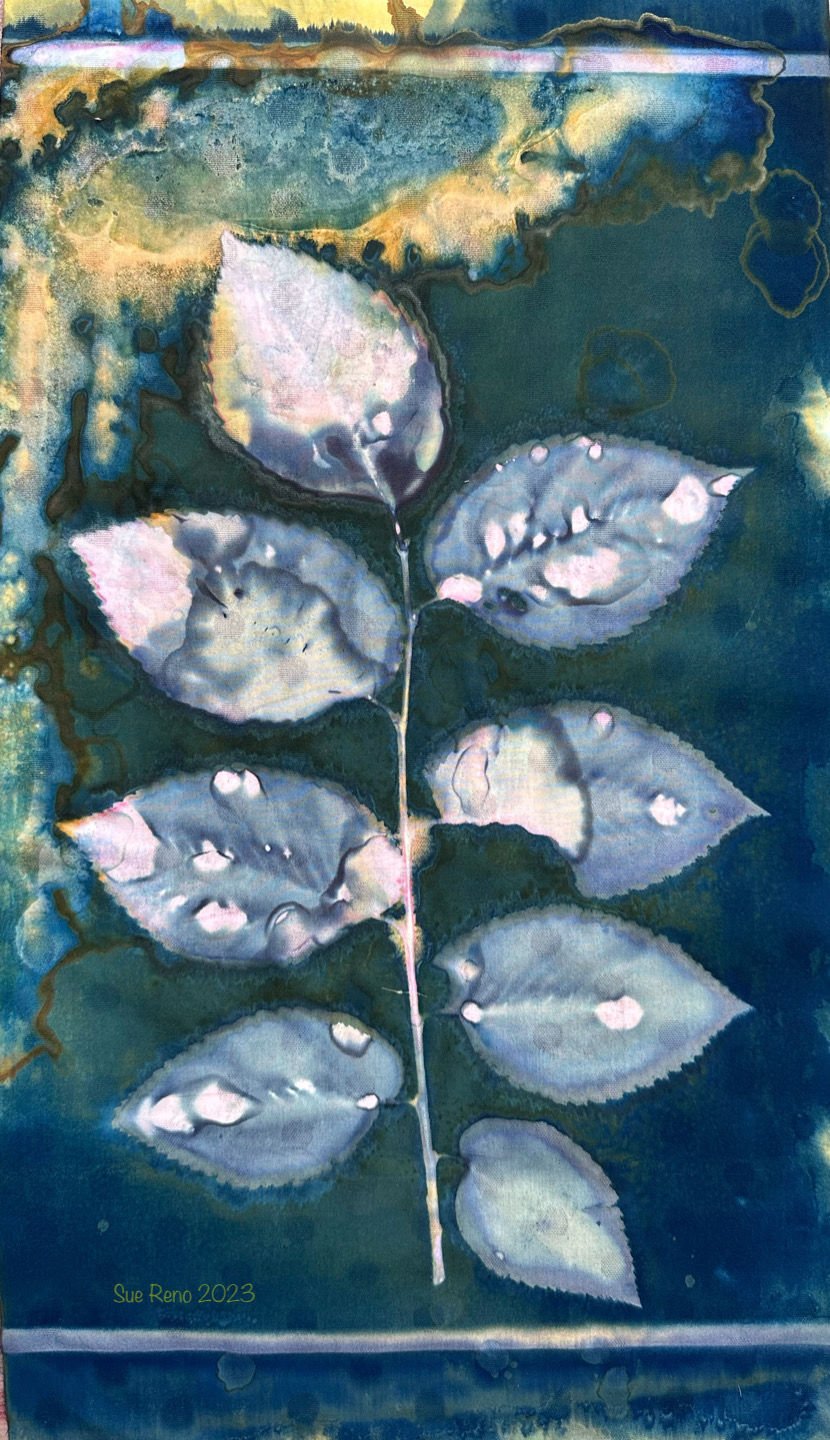
I took advantage of beautiful summery weather here in Pennsylvania to make some more wet cyanotype prints. First up is a large panel of elm leaves, using cyanotype chemicals mixed with Solarfast solar dye chemicals. Above is a large panel of elm leaves on cotton sheeting; below is the print after exposure but before rinse-out. 
Sue Reno_wet cyanotype_image 1049
Here's a medium sized panel of a single elm twig, again on cotton, after exposure and before rinse-out.
Sue Reno_wet cyanotype_image 1050
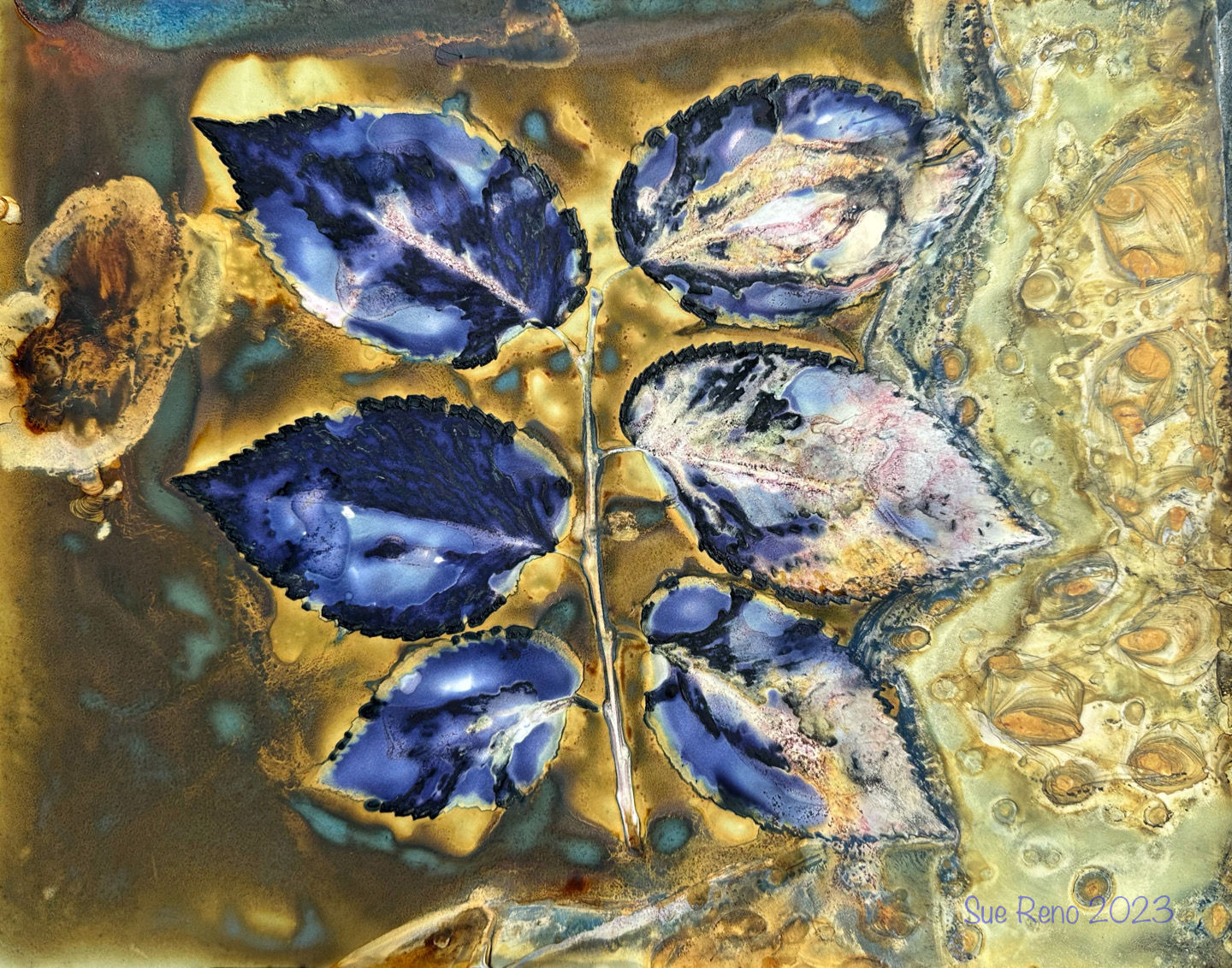
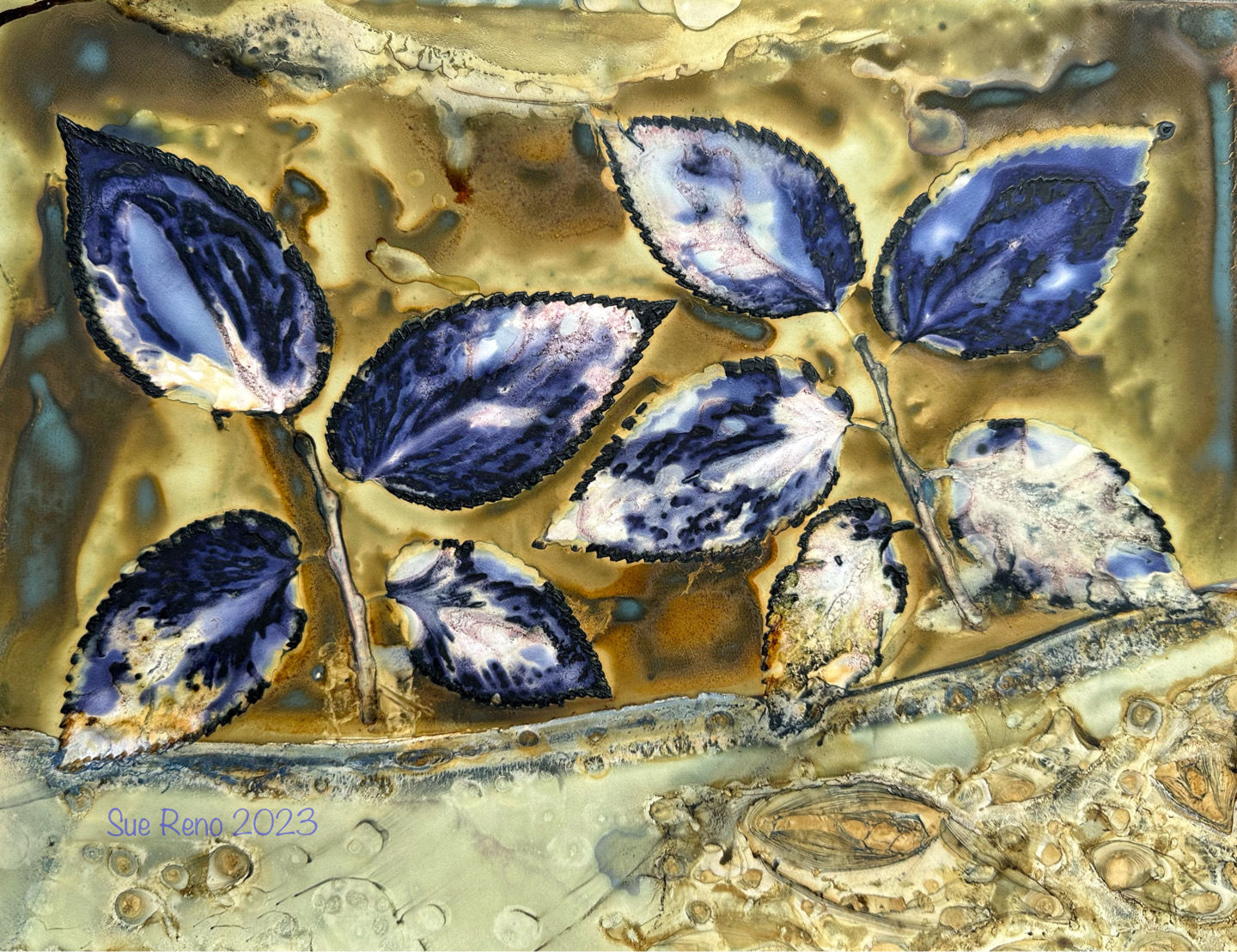
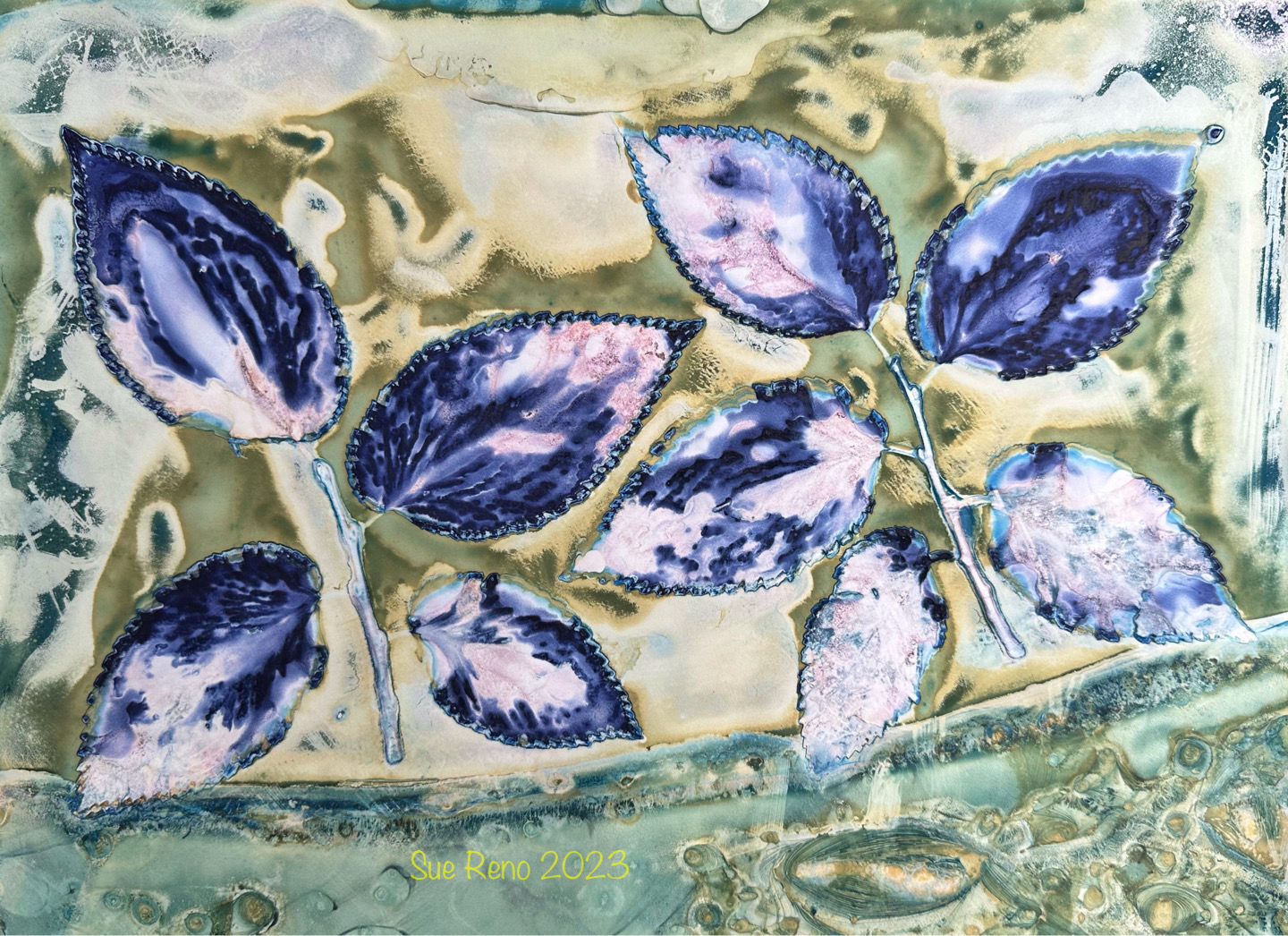
Here's two prints, after exposure, on mineral paper. It reacts very differently than fabric and I'm continued to be fascinated by it.
Sue Reno_wet cyanotype_image 1051

Sue Reno_wet cyanotype_image 1052

Here's the finished big elm leaves panel. Hot sunny days help the chemical move around during exposure in all sorts of interesting and largely unpredictable ways, and I'm very pleased with how this one turned out.
Sue Reno_wet cyanotype_image 1053
The finished single twig panel. There's a bit of a double exposure effect on the edges of the leaves, where they dried and shrank during the process.
Sue Reno_wet cyanotype_image 1054

Sue Reno_wet cyanotype_image 1055
The mineral prints are wild! They appear to be floating in a sea of anarchy.
Sue Reno_wet cyanotype_image 1056

As always, thanks for reading! A reminder that this blog is packed full of all kinds of good info, have some fun exploring the tabs in the top header. Also an admin note-- I have left the dumpster fire that was once twitter, and am now posting on Threads. Pick your platform to find and follow my content: 

August 18, 2023

Experiments in wet cyanotype - part 83

Sue Reno_wet cyanotype_image 1042
It's time for another installment of experiments in wet cyanotype! After all these years, the thrill of creating these never fades. This time around I am working with some crisp cotton sheeting that has small woven circular details. I love how the weave is adding another layer of visual interest. 

First up is a large panel with burr oak leaves, a new species for me to work with, and a medium sized print of elderberry leaves. I used my standard mix of cyanotype chemicals with just a bit of Jacquard Solarfast colors. Here they are just before exposure.
Sue Reno_wet cyanotype_image 1043
It was a warm sunny day, ideal for wet cyan, and I let them expose for about six hours. 
Sue Reno_wet cyanotype_image 1044
Here are the panels after exposure but before rinse out. I love the subtle greens that show up under the leaves; these unexposed colors always rinse out so it's fun to capture them digitally.
Sue Reno_wet cyanotype_image 1045
Here is the finished burr oak panel. I'm very happy with it and already have a plan to include it into an art quilt.

Sue Reno_wet cyanotype_image 1046
And here's the elderberry leaves panel. The colors are beautifully subtle. This one's going into the stash for later use.
Sue Reno_wet cyanotype_image 1047

As always, thanks for reading! A reminder that this blog is packed full of all kinds of good info, have some fun exploring the tabs in the top header. Also an admin note-- I have left the dumpster fire that was once twitter, and am now posting on Threads. Pick your platform to find and follow my content: 


Threads: sue_reno_studio@threads.net
Facebook page:
http://www.facebook.com/suerenostudio
Tumblr: http://suerenostudio.tumblr.com

April 2, 2023

Textiles Unleashed Acceptances

In Dreams I Slept in a Cabin, by Sue Reno
In Dreams I Slept in a Cabin
I am thrilled to announce that two of my large scale quilts, In Dreams I Slept in a Cabin and In Dreams I Went Fishing, have been accepted into the SAQA-PA exhibit Textiles Unleashed.
In Dreams I Slept in a Cabin, by Sue Reno, detail
In Dreams I Slept in a Cabin, detail
Textiles Unleashed will be at the Southern Alleghenies Museum of Art in Loretto, PA, from April 28, 2023 through July 15, 2023.
In Dreams I Went Fishing, by Sue Reno
In Dreams I Went Fishing
There will be a reception, with artist gallery talks, on Saturday, April 29.
In Dreams I Went Fishing, by Sue Reno, detail
In Dreams I Went Fishing, detail


Both quilts are from my ongoing series The River.

In Dreams I Slept in a Cabin: I lived near the mighty Susquehanna River most of my life and it is the inspiration for much of my artwork. This piece stems from a dream where I lived a simple life in a cabin near the river, lulled to sleep each night by the sound of it flowing, and awakening to its fresh beauty each morning.

Wool and silk fibers, silk and cotton fabric, cyanotypes, monoprints, needlefelting, patchwork, stitching. Size: 55"h x 94"w

In Dreams I Went Fishing: Inspired by a move to Pittsburgh, I’ve begun exploring the landscapes of the three rivers. Imagery in this quilt reflects my thoughts on the past use of the resources of the rivers by indigenous peoples, changes wrought by industrialization, and post-industrialization restoration efforts.

Materials: wool, silk, and mylar fibers; artist-painted and commercial cotton, silk, and wool fabric; embroidery thread, glass seed beads.

Technique: wet process cyanotype/solar dye, needlefelting with hand embroidery and beadwork, hand stitched patchwork, stitching. Size: 49”h x 77”w


 Thanks as always for reading! You can also follow along on your platform of choice: